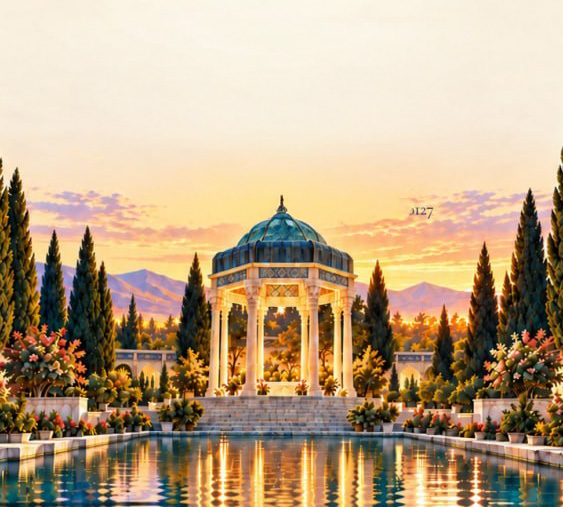
Hafez Shirazi, From the Breath of Jesus to the Rose and Nightingale: Bucharest Celebrates Hafez
University scholars, translators and Persian literature enthusiasts attend bilingual gathering
From the Breath of Jesus to the Rose and Nightingale: Bucharest Celebrates Hafez
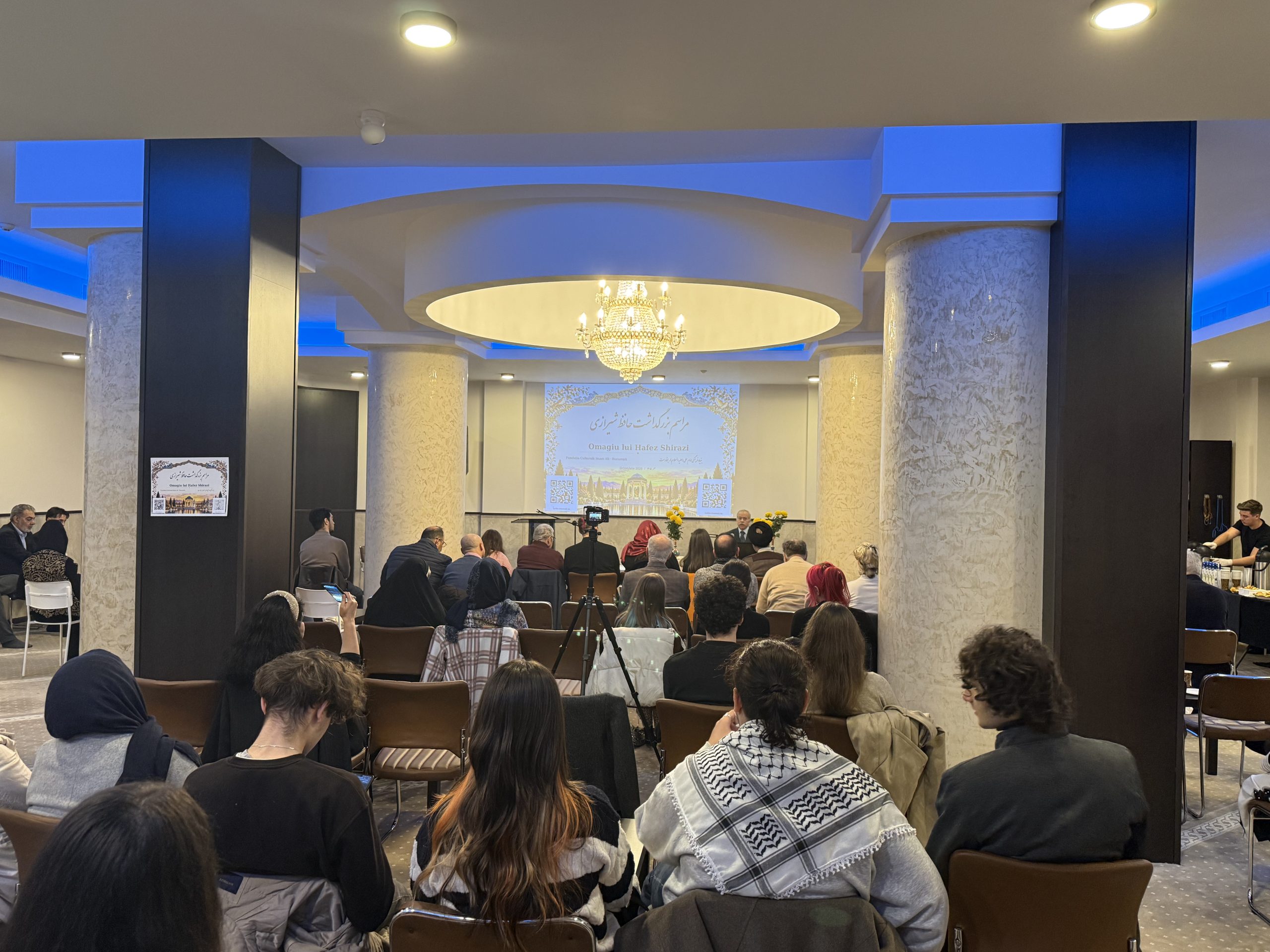
A celebration of Hafez Shirazi at the Imam Ali Cultural Foundation in Bucharest brought together Iranians and Romanian admirers of Persian literature. The bilingual programme featured university scholars and translators exploring the connections between Hafez’s poetry, spirituality, culture and world literature.
BUCHAREST — The Imam Ali Cultural Foundation hosted a celebration of Hafez Shirazi in the Romanian capital in October 2026, corresponding to Mehr 1405 in the Iranian calendar.
Members of Romania’s Iranian community joined Persian-language lecturers and students from the University of Bucharest and Romanian enthusiasts of Persian literature for the event.
Held in Persian and Romanian, the programme included readings of Hafez’s poetry with Romanian translations, talks on the imagery and ideas in the Divan of Hafez, and an introduction to Fal-e Hafez, the tradition of consulting his poems for guidance.
Opening the gathering, presenter Sepideh Dadar said: “Hafez is not only a poet of love; he is a voice of hope, wisdom, freedom and beauty a poet whose words still speak to our hearts.”
Hafez Shirazi, the Quran and the “breath of Jesus”
Seyyed Hamid Hosseini, director and imam of the Imam Ali Cultural Foundation, welcomed the opportunity for Iranians and Romanians, Muslims and Christians, to gather in celebration of Hafez.
Discussing the place of the Divan of Hafez in Iranian homes and the poet’s epithet, “Lisan al-Ghayb,” he explored the relationship between Hafez’s poetry and the Quran.
“This closeness to and familiarity with the Quran is the key to understanding Hafez,” he said.
Hosseini stated that Jesus Christ is named 36 times in the Quran and that Hafez refers to Jesus at least eleven times, almost invariably through the image of the “breath of Jesus” bringing a lifeless heart back to life.
Bucharest Celebrates Hafez Shirazi
Reading verses alongside passages from the Quran and the Gospel of John, he discussed the connections between these images. He described the springtime of Hafez’s poetry, endowed with a life-giving, Christ-like breath, as evocative of Easter.
He concluded with a couplet, rendered in translation:
“If the grace of the Holy Spirit should come to our aid once more,Others, too, may do what the Messiah once did.”
The rose and nightingale: from Persian poetry to Europe
Profesorul George Grigore, arabist român, a urmărit circulația motivului „trandafirului și privighetorii” din poezia persană, de la Rudaki la Hafez, către literaturile turcă și arabă și, ulterior, către Europa.
Romanian Arabist Professor George Grigore traced the motif of the rose and nightingale from Persian poetry, from Rudaki to Hafez, into Turkish and Arabic literature and subsequently Europe.
He referred to Oscar Wilde’s “The Nightingale and the Rose” and poems by Romania’s Alexandru Macedonski and Gabriela Mistral.
Grigore outlined two levels of meaning: earthly love between people and mystical love, in which the rose represents the centre of existence and the nightingale the soul drawn towards it
Reading Hafez through different perspectives
Dr Adela Chircu, a Persian-language lecturer at the University of Bucharest, recalled her doctoral studies in Iran, where two Persian literature professors interpreted the same ghazal on the same day through different perspectives: one mystical, the other philosophical and earthly.
Quoting the line “In the tavern of the Magi, I see the light of God,” she discussed the multiple layers of meaning in Hafez’s poetry and the place of Fal-e Hafez in Iranian Yalda Night celebrations.
She described the gathering as the first encounter with poetry’s place in Iranian life for the first-year Persian students attending.
One of Hafez’s most beautiful lessons, she said, is that “we do not all have to see the world in the same way to understand one another.”
The symbols of the Divan of Hafez Shirazi
Sara Esterabadi, a translator of Hafez’s poetry into Romanian, described the symbols of the Divan as “keys that open the doors within.” She explained wine as a symbol of mystical ecstasy and knowledge attained through the heart.
“The mystic, the lover and the philosopher can all connect with Hafez,” she said.
Esterabadi read several ghazals in Persian, including the poem beginning “At dawn, still intoxicated from the night before.” She also invited participants to try Fal-e Hafez using two copies she had brought from the first edition of her translation, “Shahd-e Eshq,” meaning “The Nectar of Love.”
Six girls from Shiraz and the tradition of Fal-e Hafez
Dr Mihai Cernătescu, a teacher of Persian language and literature who studied in Iran, recounted the well-known tale of six girls from Shiraz visiting Hafez’s tomb and asking which of them he would choose.
In the story, the answer appears in ghazal 338, in the line: “I have nothing; otherwise, I would court all six.”
After reading the poem with its Romanian translation, Cernătescu offered his interpretation of Fal-e Hafez: “It is not fortune-telling; it is consulting destiny.”
“I personally know people who have made very important decisions in their lives based on Hafez’s response,” he added.
Poetry and live music conclude the Hafez Shirazi celebration
Hamid Golshan recited two ghazals in Persian, beginning “Ya Rab in sham‘-e delafruz ze kashaneh-ye kist” and “Dast dar halqeh-ye an zolf-e dota natavan kard,” explaining the meaning of selected verses to Romanian attendees.
The celebration of Hafez concluded with live music performed by Saeed Vanoun, followed by dinner.
A digital event booklet, featuring a biography of Hafez Shirazi and selected poems with translations, is available at hafez.imamali.ro.